
How San Diego Property Taxes Are Calculated
Most buyers focus on the purchase price. Few stop to think about what they will owe in property taxes each year. A San Diego property tax calculator can give you a rough estimate. Understanding how the calculation works tells you far more. It tells you when your taxes will change, what triggers a new bill, and how to fight back. Here is what every San Diego buyer and homeowner should know.

How the San Diego Property Tax Calculator Works
The foundation is Proposition 13, passed by California voters in 1978. First, it set the base property tax rate at 1 percent of the assessed value. Additionally, it limited annual increases to no more than 2 percent per year. That means your neighbor with a home bought 20 years ago likely pays far less in taxes than you will.
For most San Diego homeowners, the base calculation is straightforward. The county assessor establishes your assessed value. From there, you apply the 1 percent base rate. Then you add any voter-approved bonds and special assessments. Those additions vary by neighborhood and can reach over 0.5 percent in Mello-Roos areas.
Any reliable San Diego property tax calculator starts with that 1 percent base. Then it layers on local levies specific to the property’s address.
What Goes Into Your Total Rate
Your total property tax rate in San Diego combines several items:
- The 1 percent state base rate
- County debt service levies
- School district bonds (varies significantly by area)
- Mello-Roos community facilities district assessments (common in newer master-planned communities)
- Other special district fees
As a result, effective total rates in San Diego County typically fall between 1.1 and 1.3 percent for most areas. Newer communities with Mello-Roos can see rates closer to 1.6 percent or higher. Consequently, knowing the exact tax rate for a specific address matters when evaluating what a home truly costs to own.
The San Diego County Assessor provides assessed value information for any property in the county. Meanwhile, the California Board of Equalization explains the statewide Prop 13 framework in full.
What Triggers a Property Tax Reassessment in San Diego
Under Prop 13, the county reassesses your property at fair market value only when ownership changes or new construction occurs. Otherwise, your assessed value increases by no more than 2 percent per year, regardless of what the market does.
A sale is the most common reassessment trigger. When you buy a home, the county reassesses it at your purchase price. That becomes your new base value. From that point forward, your assessed value can only increase by 2 percent per year until the next qualifying change.
New construction also triggers a partial reassessment. Specifically, only the new construction portion receives a new assessed value. The existing structure keeps its prior base. For example, adding an ADU triggers reassessment of that addition only, not the whole property.
What Does Not Trigger Reassessment
Several common transactions do not trigger reassessment under California law. Refinancing your mortgage does not change ownership. Therefore, it does not trigger a new assessment. Similarly, adding a co-owner spouse does not trigger reassessment in most cases.
Furthermore, Proposition 19, which took effect in 2021, changed the rules around parent-child property transfers. Under Prop 19, an inheriting child can keep the parent’s assessed value by using the property as a primary residence. However, the exclusion now tops out at the difference between assessed and market value, up to $1 million. Additionally, transfers of investment or vacation properties between parents and children no longer qualify for the exclusion. This matters for buyers who may inherit San Diego property or expect to.
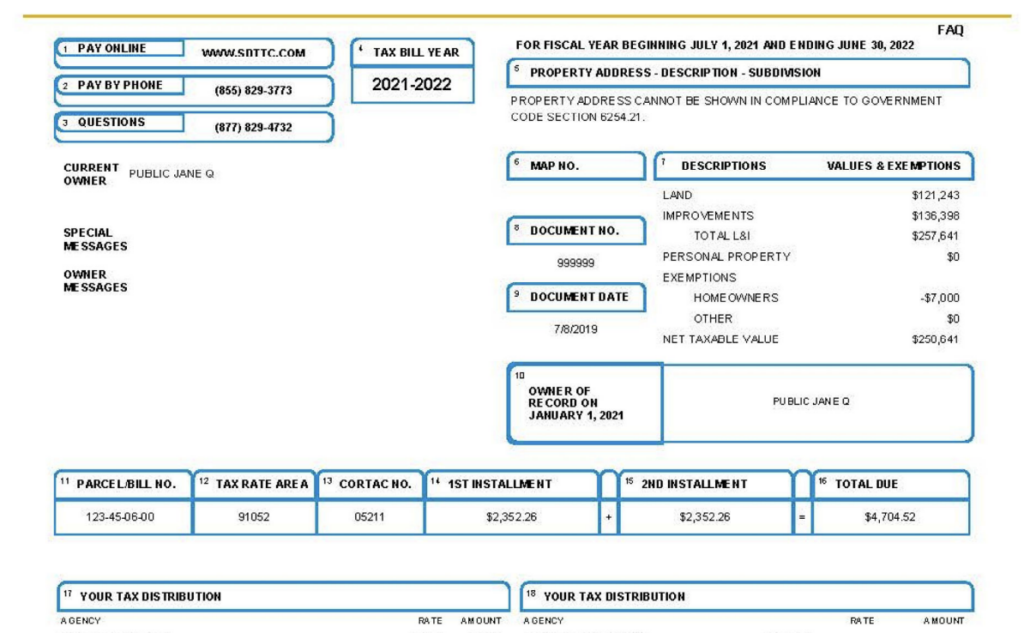
Supplemental Property Tax Bills in San Diego
When you buy a home in San Diego, you will receive a supplemental tax bill alongside your regular annual bill. The supplemental bill reflects the difference between your new assessed value and the prior owner’s assessed value. It covers the period from your close of escrow through the end of the fiscal year on June 30.
The county calculates the supplemental bill by prorating that difference across the remaining months of the tax year. For instance, a buyer who closes in November receives a bill covering approximately seven months. As a result, buyers who close mid-year should expect two separate supplemental bills if the purchase spans two fiscal years.
Furthermore, many buyers are surprised when these bills arrive because they were not part of the initial escrow calculation. In short, budget for the supplemental bill separately from your impound account. Your lender’s escrow estimate covers the annual tax but not the supplemental. Working with an experienced agent ensures you know what to expect before close.
How to Appeal Your San Diego Property Tax Assessment
If you believe your assessed value is too high, you have the right to appeal. The standard appeal window for the regular assessment roll runs July 2 through November 30 each year. Specifically, you file with the San Diego County Assessment Appeals Board during that window.
For supplemental assessments, you have 60 days from the date on the notice to file your appeal. The deadline is strict. Missing it means waiting another year.
To build a successful case, you need comparable sales data. That data should show your home’s market value was lower than the assessed value on the January 1 lien date. Also, the burden of proof is on you as the taxpayer. However, if you purchased your home recently at arm’s length, the purchase price itself is strong evidence of market value.
What This Means When You Buy in San Diego
Buying a home in San Diego means setting a new assessed value that follows you for years. Moreover, understanding the tax implications before you close allows you to make a more informed decision. Indeed, the difference between a $700,000 and a $900,000 assessed value adds up to thousands of dollars per year.
Melissa Tucci is San Diego’s Top Rated Realtor and the Official Real Estate Agent of the San Diego Padres. She helps buyers understand the full cost of ownership before they sign, not after. Browse Melissa’s current featured listings across San Diego. For more homebuying guides and market content, visit Melissa’s blog. Ready to talk? Email Melissa directly at sold@melissatucci.com.